
When people judge photographs, I often hear and read comments that all go in the same direction: “This looks unrealistic – it definitely didn’t look like that to the naked eye.”
For example, I recently came across a reel in which an influencer mocked the many current red-green aurora photos from Germany, arguing that it had looked completely different when seen with the naked eye. The conclusion was that it was somehow “fake”. Similar comments appear whenever colour saturation or white balance in photos are discussed. In today’s article, I would like to share a few thoughts on this and express my personal view.
The article is therefore also for people who may have less experience with photography and shooting techniques, but who enjoy looking at images of nature.
Three Pairs of Shoes
To get straight to the point: in my view, such subjective impressions are usually caused by one of three reasons.
First, the image has been excessively edited, meaning that most of its character was created on the computer. That does happen – and not infrequently.
Second, the viewer only accepts subjects, colours, shapes and impressions that they have already seen themselves and/or consider realistic. This happens too, but increasingly less often.
Third, the image was created using equipment and shooting techniques that are partly or entirely unfamiliar to the viewer. In my opinion, this occurs even more frequently than the first point and is the main focus of this article.
In the example of the auroras, the comments mentioned above were clearly related to the third point (I had seen the images she was referring to). The viewer had confused one crucial thing:
Photographing is not the same as seeing. Just because one cannot easily comprehend perspectives, blur, colours, structures or brightness does not mean that the image was created on a computer.
Let’s Be Specific
Let’s take a closer look in practice at what I mean. I’ll go into detail once, and then briefly cover a few further examples.
First, I’ll show you a truly beautiful image 😅
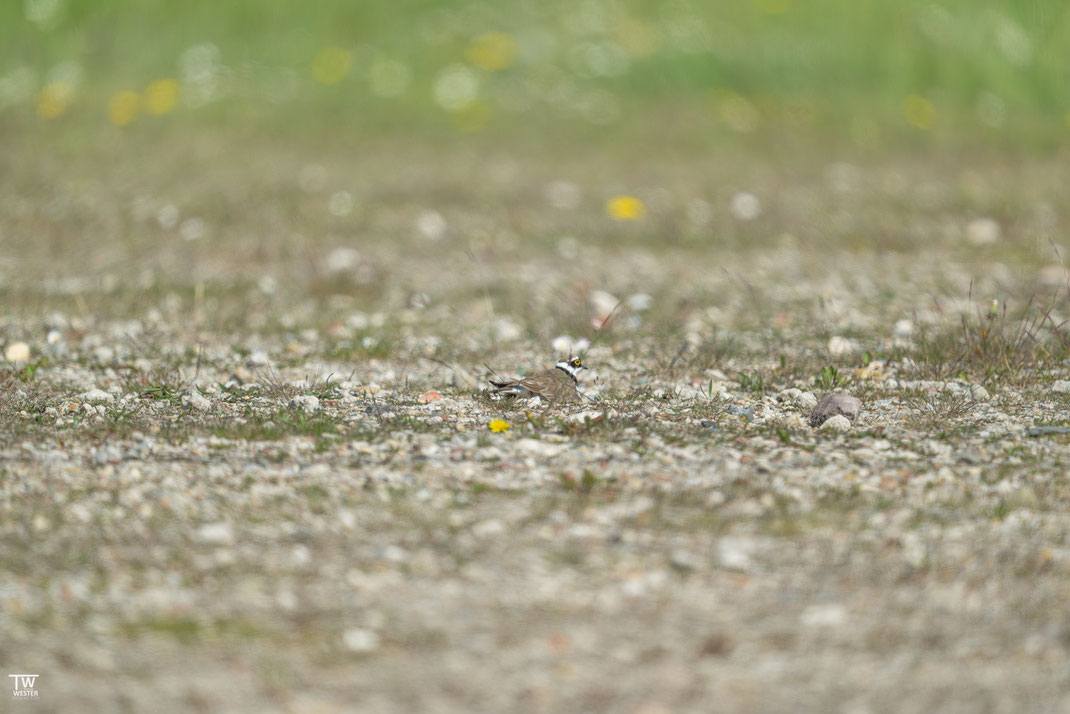
This is, of course, a documentary photograph. It shows – using a slightly longer focal length and good equipment – the now greened-over edge of a disused car park, where a little ringed plover is sitting (see centre). Here, I used the telephoto lens almost like binoculars and took the image on my first visit to this location in order to get a feel for the situation.
This is roughly how the scene appeared to the human eye, apart from the blur in the foreground and background, which of course we do not perceive in the same way.
I was delighted to be able to observe a “Fluppi” for the first time at that moment. However, I found neither the habitat nor the colours particularly attractive. Still, I found photographic solutions to present the scene in a visually pleasing way from my perspective.
- I decided on a high-key approach, as this was the only way for the grey-green surroundings to take on a naturally soft, pastel tone.
- Consequently, I returned on another day when the light allowed for such a bright image – this does not work as soon as even a hint of direct light hits the bird. Especially because of the white plumage, both time of day and cloud cover have to be just right.
- In order to dissolve the habitat, I had to get much lower than any ground-level tripod and head would allow. I even had to flip up the tripod collar and ended up photographing almost buried in the gravel. Only then could I achieve this “dreamy”, isolated look.
- The rest is easy – wide open aperture, bright exposure just before the end of the histogram, and done. Oh, and of course what felt like a hundred attempts until the bird finally stood still in the perfect position.
This is what the final image looked like:

Viewed in abstract terms, the scene was created through a combination of several shooting techniques, the right weather conditions, and a high-performance lens with pleasing bokeh. One may like or dislike the result – but it was not created on a computer.
Now let’s revisit the statement: is this “real, the way the human eye sees it”? Good heavens, no! The first, “ugly” version comes much closer to reality.
Does that make the image “fake”? Once again, a clear no – it was simply created using a craft known as photography.
Six Further Typical Examples
You don’t need a super-telephoto lens for images where the final result differs greatly from what is visible to the eye. So let’s look at a few more examples where the impression of an image is often questioned, even though the explanation lies entirely in photography.
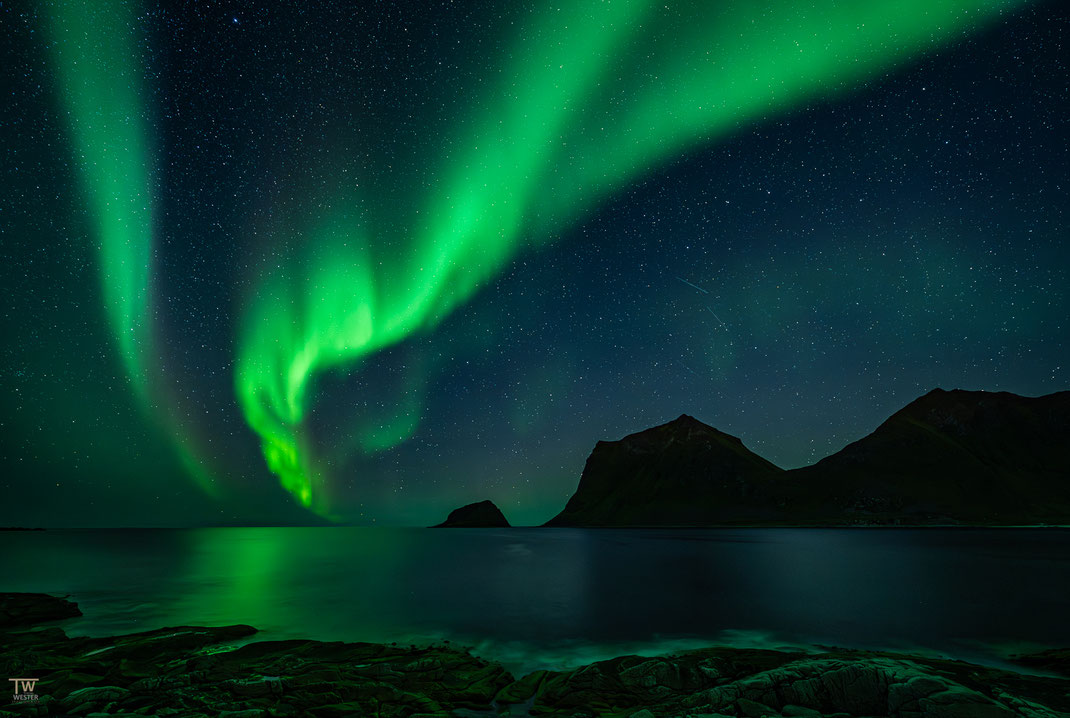
Did the auroras really glow such an intense green? Was the sky slightly bluish? Twice no – and yet the image was not created on a computer.
The explanation is simple: a camera sensor can collect more photons through long exposure times and high ISO values and amplify them electronically. The human eye, on the other hand, relies mainly on rod cells in low light conditions. These are very sensitive to light, but barely perceive colour differences in the dark. This is why auroras and stars, for example, stand out so clearly. In addition, I had set a very cool white balance on site.
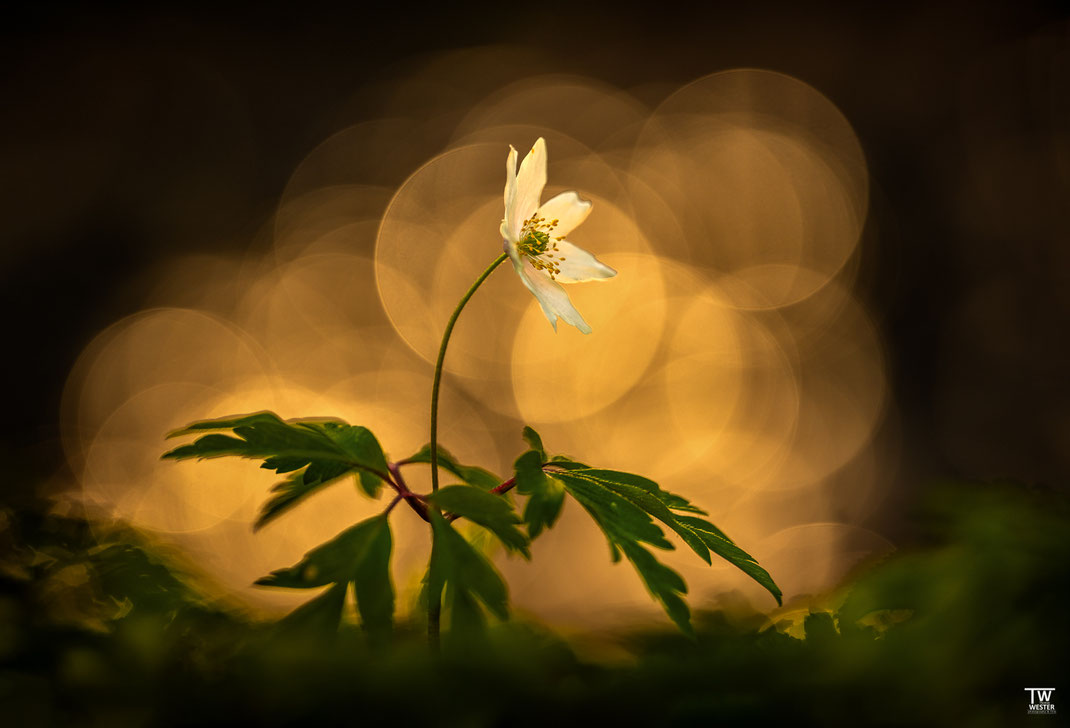
Did I see these beautiful “bokeh balls” with my naked eye? Nope. These circles appear because out-of-focus points of light project the shape of the aperture opening onto the sensor. Their exact form is mainly determined by the aperture and optical imperfections of the lens.

Waterfalls are another frequent “Photoshop suspicion”. This is also something the human eye cannot see – only long exposure can achieve this effect. With long exposure photography, many temporally offset image impressions are recorded on top of one another. Movements and light patterns merge into soft structures, similar to brushstrokes in painting.
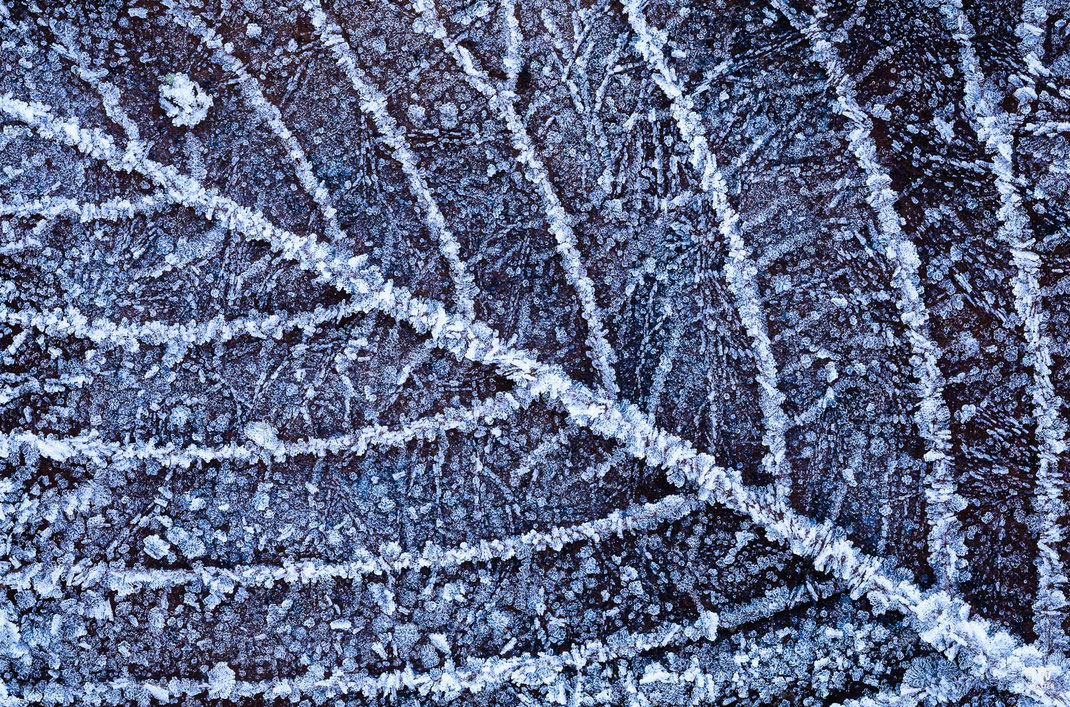
Do I see ice crystals with the naked eye? Not really – not even with my new reading glasses. But with a specialised macro lens, you can, and if the camera is used accordingly, it looks something like this.
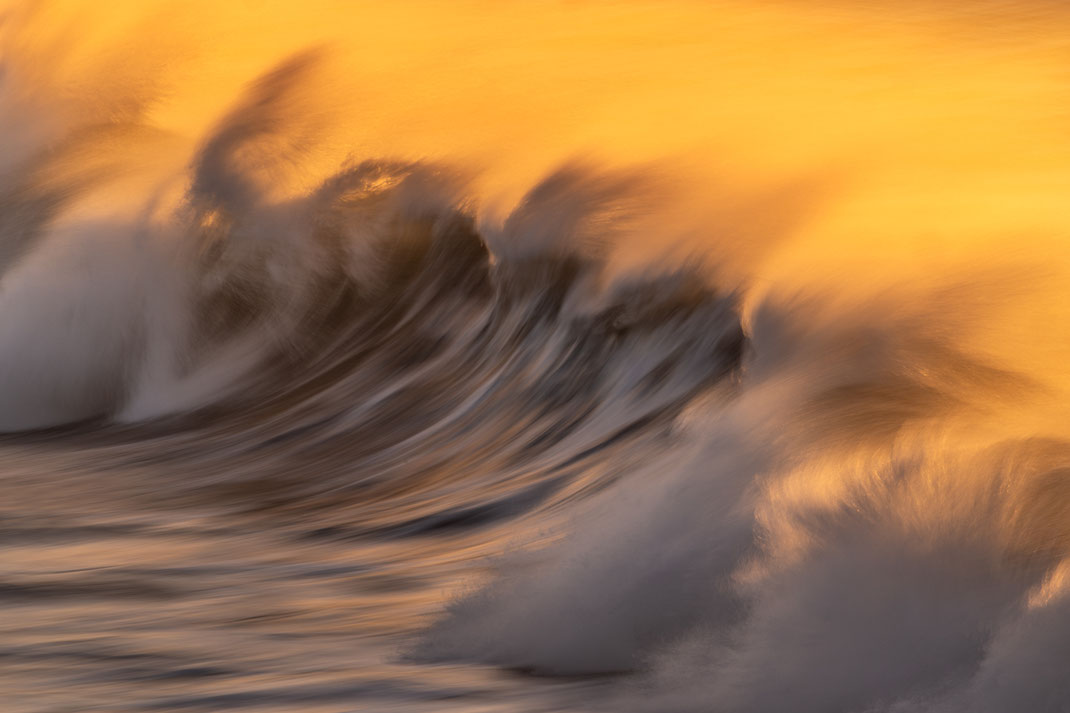
Here, too, no graphic editing is involved, and yet I perceive the wave differently on site. So-called ICM shots (Intentional Camera Movement) are created when the camera is deliberately moved during a long exposure. This causes subjects to blur into lines, shapes and gradients of colour, giving the image an abstract, painterly, artistic character. The real challenge is “simply” choosing the exact right exposure.

And these scenes are not created on a PC either – here, extremely short shutter speeds are combined with a kind of low-key shooting technique, resulting in an image like this. I would never have been able to perceive this 1/3200th of a second with the naked eye.
I’ll leave it at that, although one could easily discuss another fifty aspects and techniques. I think the conclusion can now be summed up quite succinctly:
One of the greatest fascinations of photography lies precisely in its ability to depict things that the human eye cannot see. This is often what nature photography is all about.
As a nature photographer, my wish would be that viewers do not judge images too hastily and at least consider the possibility that impressions which appear unrealistic may well be achieved photographically – and not on a computer.
That’s all for today. Thank you very much for your interest, and kind regards,
Thomas